
Tuozi (托子): How Trestle-Table Legs Tenon Into a Long Shoe
Straight shoe · 直托子 · leg-to-shoe
Under a tiao’an (trestle table) the feet do not stand on a closed mitred frame.
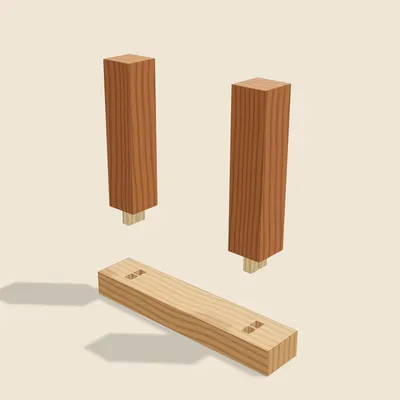
Wang’s straight shoe (直托子) is a long runner: each leg puts two tenons into it, two shoes take four legs, and nothing ties the shoes across.
- Chinese
- 托子 · tuōzi (直托子)
- Joins
- Trestle-table legs to a long shoe
- Found in
- Trestle tables (条案)
- Signature
- Two tenons per leg · long shoe · no cross member
- Related
- Base frame (托泥) · Clasping-leg
How it works
A shoe, not a closed base frame
Wang Shixiang’s Fig 3.40 (直托子) shows a long shoe under a trestle-table pair: mortises at both ends of the shoe, each leg ending in two tenons that drop into those mortises (p. 116). Two such shoes take the four legs. He notes that no cross member ties the shoes together.
Why it is not 托泥
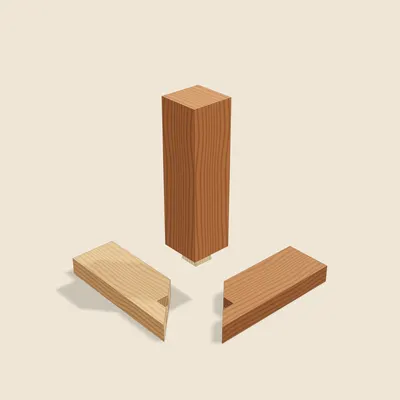
A tuoni is a continuous mitred frame of four members. In the usual method, a mortise at each corner takes a foot tenon cut from the leg or planted separately (fig. 3.41a, p. 117). A more complex flared open mortise, narrow at the top and wide at the bottom, locks once the frame is assembled (fig. 3.41b, p. 117). A tuozi is a pair of independent long runners.
History
Wang’s straight shoe
In the bases section Wang places the straight shoe (直托子) next to the mitred tuoni: trestle-table legs put two tenons into a long shoe; two shoes carry four legs; nothing cross-ties the shoes (p. 116, Fig 3.40). The figure is the construction idea, not a millimetre schedule for every table.
Proportions
Two tenons, illustrative sizes
Wang states two tenons per leg into the shoe ends. He does not fix shoe height, tenon length, or spacing for every trestle table. Builders size from the actual leg section.
Proportions in the model are illustrative.
Common mistakes
- Calling it a tuoni. Tuoni is a closed mitred frame; tuozi is a pair of long shoes.
- Adding a cross member “to finish the base.” Wang’s note is that the shoes are not tied across.
- One fat tenon instead of two. The figure shows two tenons on each leg end.
Related joints elsewhere
Elsewhere
Western trestle shoes and sled feet are reading bridges only. Compare the continuous base frame and recessed-leg tops such as jiatou.
How it's made
 Step 1
Long shoe
A long shoe under a trestle-table pair.
 Step 2
Mortises
Mortises at both ends of the shoe.
 Step 3
Two tenons
Each leg ends in two tenons.
 Step 4
Drop in
Legs drop into the shoe.
 Step 5
Two shoes
Two shoes take four legs.
 Step 6
No cross-tie
No member ties the shoes together.
Variations
Second shoe
The other pair of legs stands on an identical shoe.
Can you CNC this?
Moderate as drawn: two blind tenons per leg into a long shoe are straight pockets a 3-axis cutter can reach from the shoe top; watch grain run-out on a thin shoe and keep the two mortises from breaking into each other.
Free STL downloads (one file per part)
- Straight shoe 直托子 · tuozi-shoe.stl
- Near leg with two tenons 近端腿足(出两榫) · tuozi-leg-near.stl
- Far leg with two tenons 远端腿足(出两榫) · tuozi-leg-far.stl
Before cutting or printing, read the CNC and 3D-printing notes on tool radius, scaling the STL files and their licence.
Where you’ll see it
- Recessed-leg table · Feet on shoes (when used): Some trestle tables put each leg’s two tenons into a long shoe (tuozi) rather than a closed mitred base frame.
- Portable long table (everted-end table) · Shoes under the legs: On long tables the foot of each leg carries two tenons into mortises at the end of a shoe; the two shoes each carry a pair of legs, and no member joins the two shoes. Typical practice (Wang Shixiang p.117).
Terms on this page: 托子 (shoe (trestle runner))
Related joints
Leg and Base Frame
tuǐzú yǔ tuōníA mitred frame of four members. In the usual method, a mortise at each corner takes a foot tenon cut from the leg or planted separately; cutting it from the leg is the sounder method (fig. 3.41a). A more complex flared open mortise, smaller above and larger below, locks once the frame is assembled (fig. 3.41b).
Elongated Bridle Joint
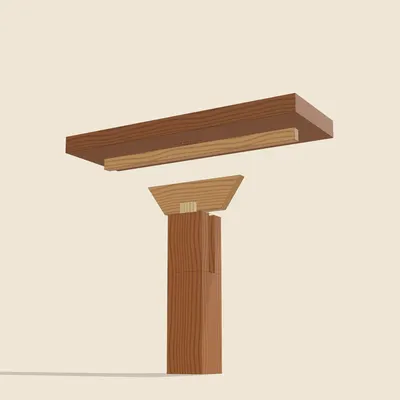
jiātóu sǔnThe leg top is slotted to clamp the apron and its spandrel heads, then tenons into the top.
Inserted-Shoulder Joint
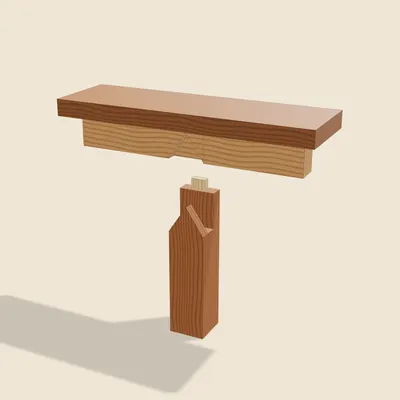
chājiān sǔnThe leg is cut to a pointed shoulder that the grooved apron straddles, finishing flush; the heavier the top, the tighter it grips.
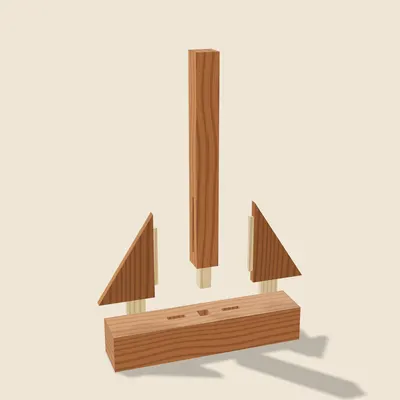
Block Base with Standing Spandrels
dūnzuòA tall upright mortised into a heavy wooden block and clamped front and back by two standing spandrels.
Questions
What is a tuozi?
A long shoe under trestle-table legs: each leg puts two tenons into the shoe; two shoes take four legs.
Is it the same as a tuoni?
No. Tuoni is a continuous mitred base frame; tuozi is a pair of independent long runners with no cross member between them.
Why two tenons?
Wang’s Fig 3.40 shows each leg ending in two tenons into the shoe.
Where is it used?
On trestle tables (条案) whose feet stand on shoes rather than a closed base frame.
Further reading
- 王世襄《明式家具研究》(Wang Shixiang, Research on Ming Furniture),第 116 页,图 3.40「直托子」