
Cuandou (攒斗): Openwork Lattice Built from Short Pieces and Loose Tenons
Cuandou · Cuandou lattice · 攒斗 · Lantern lattice
The openwork panels of Ming bed railings and cabinet doors look carved, but most are built from many short pieces.
Each butt joint is held by a tiny hidden tenon. This kind of work is called cuandou.
- Chinese
- 攒斗 · cuándòu
- Joins
- Short straight pieces to each other and to the frame
- Found in
- Bed railings, open shelves, lattice doors
- Signature parts
- Short pieces · butt joints · loose tenons
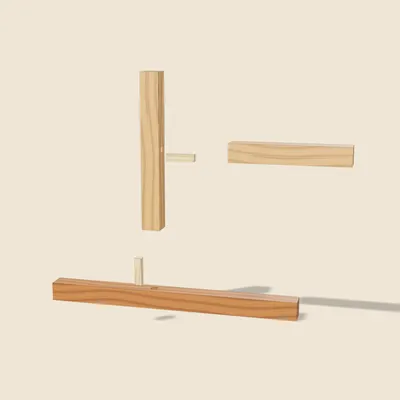
How it works
Many short pieces
Patterns such as the lantern lattice are not cut from one board. They are put together from many short straight pieces, each butted against its neighbours or against the frame.
Loose tenons at every butt
A short piece is too small to carry its own tenon across the grain, so each butt joint gets a small separate tenon (栽榫) set into both pieces. Wang Shixiang lists these lattice patterns, such as four-way cloud and cross-and-square designs on bed railings and cabinet doors, among the places where loose tenons are used. His drawing of a lantern lattice marks a small tenon at each butt.
What you see
From the front only the fine joint lines show; the tenons stay inside.
How it's made
 Step 1
Lattice
A lattice of short pieces.
 Step 2
Short pieces
Each piece is short and straight.
 Step 3
Loose tenons
Small separate tenons.
 Step 4
To the frame
A piece is joined to the frame.
 Step 5
To each other
Pieces are joined to each other.
 Step 6
Hidden
No tenon shows on the face.
Variations
Patterns
Lantern lattice, four-way cloud, cross-and-square and similar designs use the same method.
Can you CNC this?
Yes, with small changes
Every short piece is a straight bar with a small pocket in each end, and the loose tenons are tiny rectangular sticks; all are simple 3-axis cuts. The small pockets need a small bit, and their round corners need squaring or rounded tenons.
Free STL downloads (one file per part)
- Frame side 边框 · zandou-frame.stl
- Loose tenon (to frame) 栽榫(接边框) · zandou-loose-tenon-frame.stl
- Short piece (upright) 短材(竖) · zandou-short-piece-upright.stl
- Loose tenon (piece to piece) 栽榫(短材互接) · zandou-loose-tenon-piece.stl
- Short piece (cross) 短材(横) · zandou-short-piece-cross.stl
Before cutting or printing, read the CNC and 3D-printing notes on tool radius, scaling the STL files and their licence.
Related joints
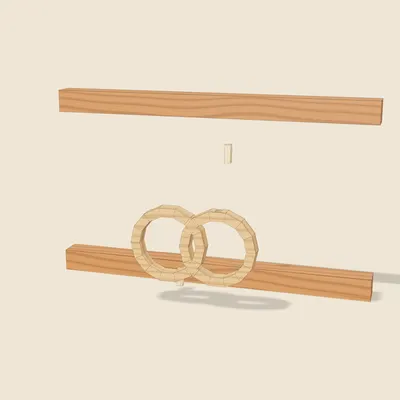
Carved Spacer with Loose Tenons
qiǎzihuā zāisǔnA carved spacer between a stretcher and the member above, held by separate loose tenons into each.
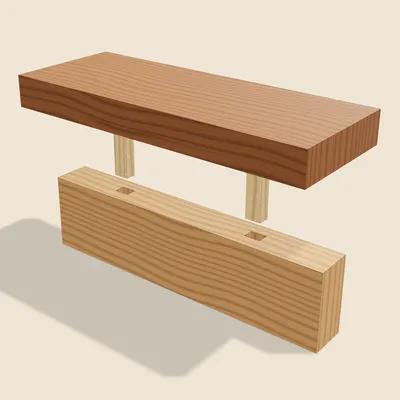
Loose Tenon
zāi xiāoThe tenon is a separate piece of wood planted into mortises in both parts, easy to replace if it wears.
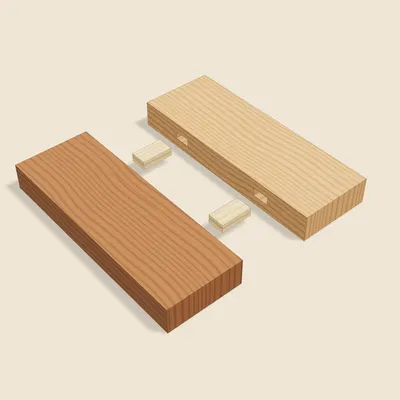
Loose-Tenon Board Joint
zāisǔn pīnbǎnThick boards are joined edge to edge with separate straight tenons planted into mortises in both edges.
Questions
Why loose tenons?
The pieces are too short to cut sound tenons of their own.
Where is it used?
Bed railings, open shelves and lattice doors.
Is it carved?
No. It is assembled from many small pieces.
Further reading
- 王世襄《明式家具研究》(Wang Shixiang, Research on Ming Furniture),第 118 页,图 3.44a
- 王世襄《明式家具研究》(Wang Shixiang, Research on Ming Furniture),第 119 页