
Kazihua (卡子花): Carved Spacers Fixed with Loose Tenons
Carved spacer · 卡子花
Short posts between a stretcher and a top can be plain. Carved, they become kazihua.
A delicate carving cannot carry its own tenons, so separate ones are set in.
- Chinese
- 卡子花 · kǎzihuā
- Joins
- Spacer to stretcher and to apron or top frame
- Found in
- Tables, stools, chairs
- Signature parts
- Carved spacer · loose tenons
- Compare
- Short post
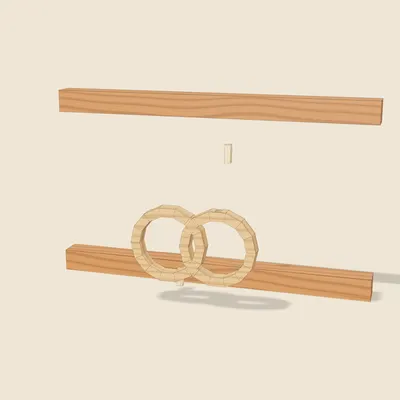
How it works
From short post to carving
Wang Shixiang describes the carved spacer as a decorated short post. On pieces without a waist it runs from the stretcher to the underside of the top frame; with a waist, from the stretcher to the apron.
Three ways to fix it
A spacer may have tenons cut on itself, take separate loose tenons, or be pinned through, depending on its shape. Thin interlocked forms such as the double ring use loose tenons, one into the member above and one into the stretcher below.
Proportions in the model are illustrative.
How it's made
 Step 1
Spacer
A carved spacer between two members.
 Step 2
Too thin
Too thin to cut its own tenons.
 Step 3
Loose tenons
Separate loose tenons.
 Step 4
Below
One into the stretcher.
 Step 5
Above
One into the member above.
 Step 6
Held
Held top and bottom.
Variations
Own tenons
Solid spacers can have tenons cut on themselves.
Pinned through
Some are fixed with a pin through.
Can you CNC this?
Yes, with small changes
A flat carved spacer is a 2D profile, and the loose-tenon sockets are small pockets drilled or milled straight in. Any carved relief on the face is separate 3D work.
Free STL downloads (one file per part)
- Stretcher 枨子 · kazihua-zaisun-stretcher.stl
- Carved spacer (double ring) 卡子花(双套环) · kazihua-zaisun-carved-spacer.stl
- Member above 上方构件 · kazihua-zaisun-upper-member.stl
- Loose tenon (top) 栽榫(上) · kazihua-zaisun-loose-tenon-top.stl
- Loose tenon (bottom) 栽榫(下) · kazihua-zaisun-loose-tenon-bottom.stl
Before cutting or printing, read the CNC and 3D-printing notes on tool radius, scaling the STL files and their licence.
Related joints
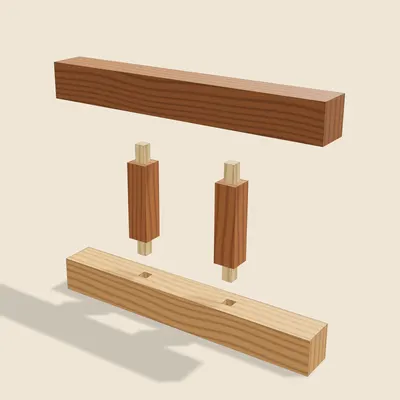
Short Struts
ǎilǎoShort vertical struts between a stretcher and the member above, tenoned at both ends.
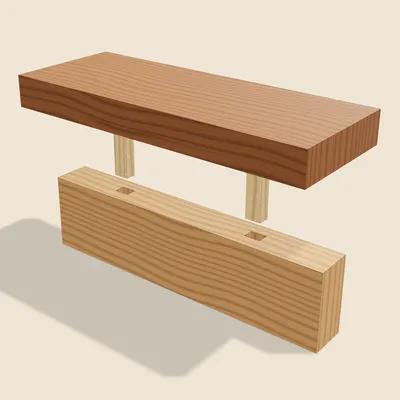
Loose Tenon
zāi xiāoThe tenon is a separate piece of wood planted into mortises in both parts, easy to replace if it wears.
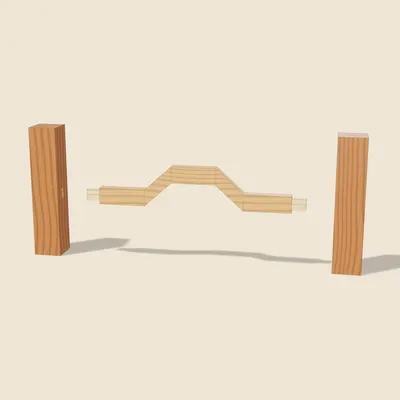
Hump-Backed Stretcher
luóguō chéngA stretcher that is low at both ends and arched up in the middle: its joints sit low on the legs where they brace best, while the middle leaves room for the knees.
Questions
What is a kazihua?
A carved spacer standing in for a short post.
Why loose tenons?
The carving is too thin to carry its own.
Where is it seen?
Between stretchers and tops on tables and stools.
Further reading
- 王世襄《明式家具研究》(Wang Shixiang, Research on Ming Furniture),第 114 页
- 王世襄《明式家具研究》(Wang Shixiang, Research on Ming Furniture),第 118 页,图 3.44b
- 王世襄《明式家具研究》(Wang Shixiang, Research on Ming Furniture),第 119 页