
Yi Tui San Ya (一腿三牙): One Leg and Three Aprons in a Ming Square Table
One leg three aprons · 一腿三牙方桌
On a classic Ming square table the legs are set in from the corners.
That leaves room for a third apron: a small spandrel across each corner. Hence the name one leg, three aprons.
- Chinese
- 一腿三牙 · yī tuǐ sān yá
- Joins
- Leg, two long aprons, corner spandrel, top
- Found in
- Ming square tables
- Signature parts
- Inset leg · corner spandrel · loose tenons
- Compare
- Loose tenon
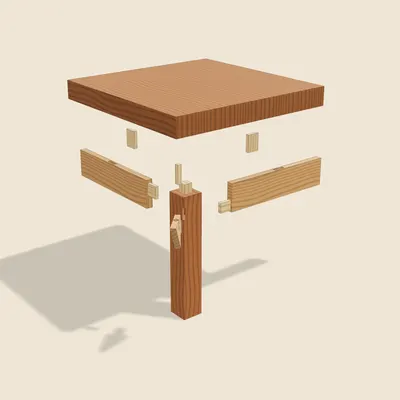
How it works
Three aprons at one leg
The legs stand a little in from the corners of the top. Two long aprons run along the sides and tenon into the leg, and a small spandrel sits across the corner of the table on the diagonal. Every leg therefore meets three aprons.
Loose tenons
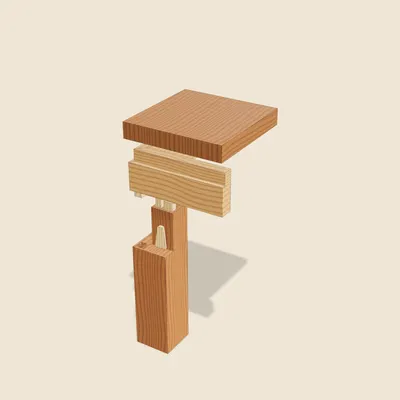
Wang Shixiang lists the top edge of a table’s aprons, and the top edge of the thickened border on a one-leg-three-aprons table, among the places where loose tenons (栽榫) join a part to the underside of the top frame. The corner drawing in his book shows them in the top edges of the aprons and the spandrel.
Why the inset leg
Setting the leg in from the corner shortens the span of the top and lets the corner spandrel brace the overhang.
Proportions in the model are illustrative.
How it's made
 Step 1
Three aprons
One leg, three aprons.
 Step 2
Long aprons
Two long aprons tenon into the leg.
 Step 3
Spandrel
A spandrel across the corner.
 Step 4
Loose tenons
Loose tenons in the top edges.
 Step 5
Top
The top goes on over them.
 Step 6
Inset leg
The leg is set in from the corner.
Variations
Thickened border
The top often has a thickened border (垛边) under its edge.
Can you CNC this?
Possible, with design or setup changes
The aprons, their tenons and the mortises in the leg are ordinary cuts. The corner spandrel meets the leg on the diagonal, which may need the leg clamped at 45°. The loose-tenon sockets are simple pockets.
Free STL downloads (one file per part)
- Leg 腿足 · yitui-sanya-leg.stl
- Long apron (front) 长牙条(正面) · yitui-sanya-apron-front.stl
- Long apron (side) 长牙条(侧面) · yitui-sanya-apron-side.stl
- Corner spandrel 桌角牙头 · yitui-sanya-corner-spandrel.stl
- Top (simplified slab) 桌面(简化为整板) · yitui-sanya-top.stl
- Loose tenon (front apron) 栽榫(正面牙条) · yitui-sanya-loose-tenon-front.stl
- Loose tenon (side apron) 栽榫(侧面牙条) · yitui-sanya-loose-tenon-side.stl
- Loose tenon (spandrel) 栽榫(牙头) · yitui-sanya-loose-tenon-spandrel.stl
Before cutting or printing, read the CNC and 3D-printing notes on tool radius, scaling the STL files and their licence.
In museum collections
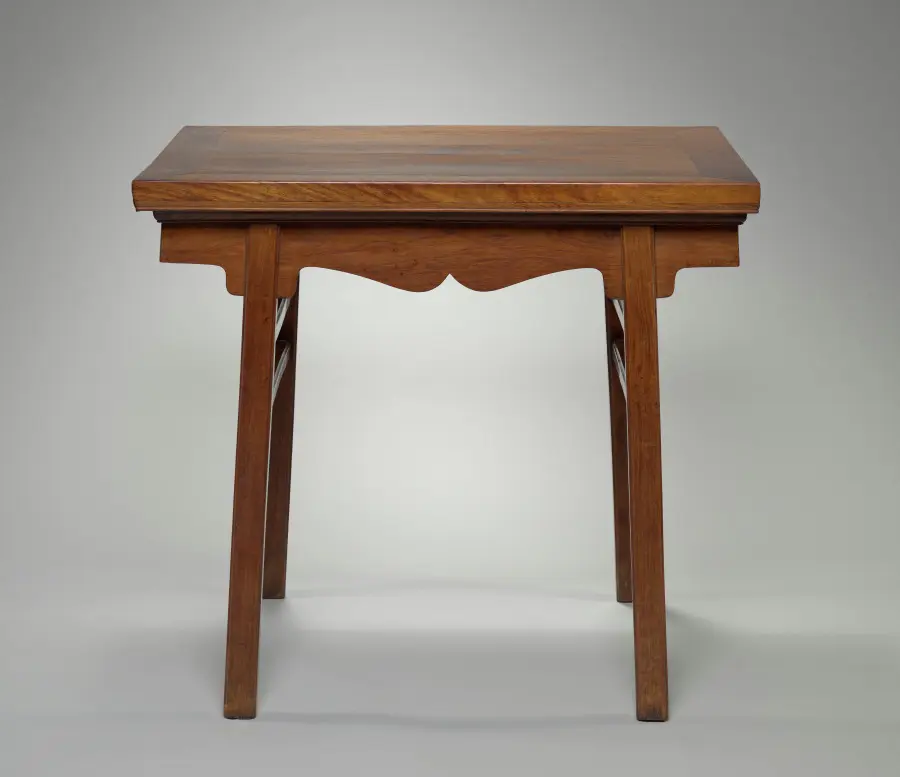
Cleveland Museum of Art
Where you’ll see it
- One-leg-three-aprons table · Aprons to the top: The thin aprons and the corner spandrel cannot easily carry their own tenons; loose tenons in their top edges go into the underside of the top.
- One-leg-three-aprons table · Leg and three aprons: Two long aprons tenon into the leg from the sides; a small spandrel sits across the corner on the diagonal.
Related joints
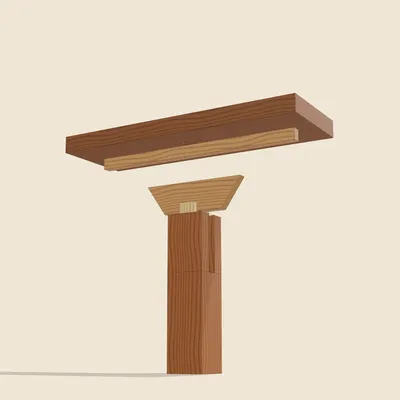
Elongated Bridle Joint
jiātóu sǔnThe leg top is slotted to clamp the apron and its spandrel heads, then tenons into the top.
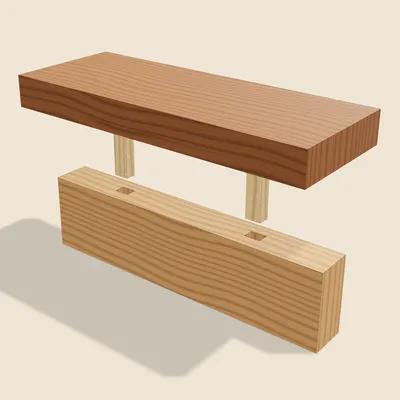
Loose Tenon
zāi xiāoThe tenon is a separate piece of wood planted into mortises in both parts, easy to replace if it wears.
Baojian Joint
bàojiān sǔnThe hidden lock behind every waisted Ming table corner: a mitred shoulder, a triangular tenon and a tapered pin.
Questions
What are the three aprons?
Two long aprons and the small corner spandrel.
Why loose tenons?
The thin aprons cannot easily carry their own tenons into the top.
Where is it seen?
Mostly on Ming square tables.
Further reading
- Game table, 1600s, Cleveland Museum of Art (collection record)
- 王世襄《明式家具研究》(Wang Shixiang, Research on Ming Furniture),第 119 页,图 3.44c
- 王世襄《明式家具研究》(Wang Shixiang, Research on Ming Furniture),第 119 页
- 王世襄《明式家具研究》(Wang Shixiang, Research on Ming Furniture),第 110 页