
Xunzhang Langan (寻杖栏杆): How a Chinese Veranda Railing Is Joined
Veranda railing · 寻杖栏杆
Verandas of Chinese halls are fenced with a low railing between the columns.
It is made as one piece and then dropped into place.
- Chinese
- 寻杖栏杆 · xúnzhàng lángān
- Joins
- Handrail and rails to posts; posts to columns
- Found in
- Verandas and galleries
- Signature parts
- Rail tenons · sliding key
- Compare
- Back-drawn sill tenons
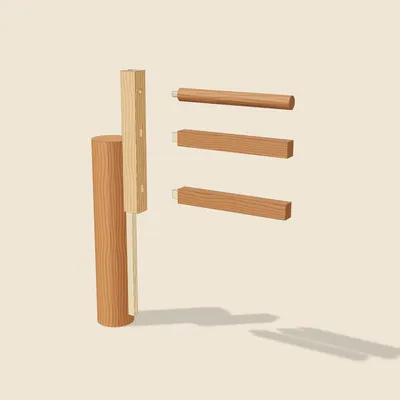
How it works
The parts
A handrail railing has posts (望柱), a round handrail at the top, a middle rail and a bottom rail, small panels between them divided by short posts, a vase-shaped baluster under the handrail, and a sill on the floor. The handrail is round and tenons into the posts at both ends; the middle and bottom rails are square and also tenon into the posts. All the horizontal members sit on the inside of the posts.
Fitting between columns
The railing is usually made complete and fitted as a whole. The post’s face against the column is shaped to its curve; then sliding keys (溜销) are fixed to the column and the railing is dropped in from above.
The baluster, short posts, panels and sill are not modelled, as their joints are not described.
Proportions in the model are illustrative.
How it's made
 Step 1
Railing
A railing between columns.
 Step 2
Tenons
Every rail ends in a tenon.
 Step 3
Into the post
Rails go into the post.
 Step 4
Key
A sliding key on the column.
 Step 5
Drop in
Dropped in from above.
 Step 6
Inside
Rails sit inside the posts.
Variations
Plain railing (花栏杆)
Posts, rails and a lattice of bars, used in houses and gardens.
Bench railing (坐凳楣子)
A low frame with a seat board on top, for sitting.
Can you CNC this?
Possible, with design or setup changes
Square rails and their tenons are simple; the round handrail's tenon and the post face shaped to the column curve need turning or a profile cut.
Free STL downloads (one file per part)
- Eave column with sliding key 檐柱(带溜销) · xunzhang-langan-column.stl
- Railing post 望柱 · xunzhang-langan-railing-post.stl
- Handrail and rails 扶手与腰枋、下枋 · xunzhang-langan-rails.stl
Before cutting or printing, read the CNC and 3D-printing notes on tool radius, scaling the STL files and their licence.
Related joints
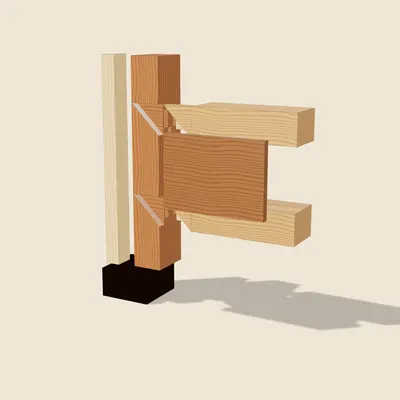
Lattice Door Frame
géshàn biānmǒThe rails of a lattice door join the stiles with two tenons and a mitred face; panels sit in grooves, and a pivot post fixed to the stile turns in sockets.
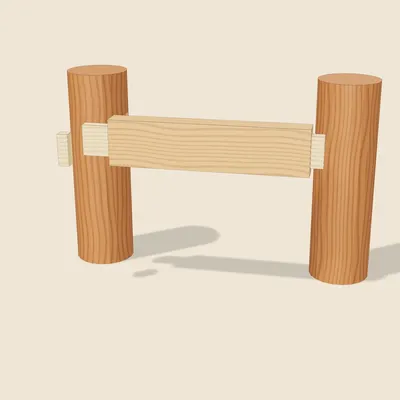
Back-Drawn Sill Tenons
dàotuì sǔnA sill fitted between standing columns has one long and one short tenon: the long end goes in first, then the sill is drawn back so the short end enters, and the gap is packed.
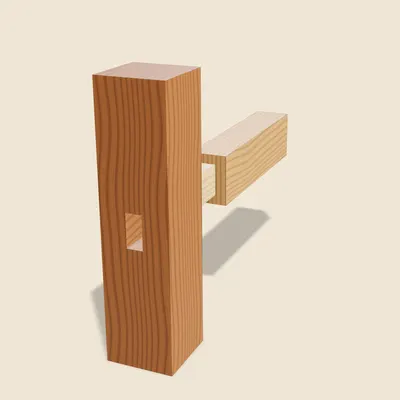
Through Tenon
tòu sǔnThe tenon runs right through and its end grain shows on the far side: strong, but less neat than a blind tenon.
Questions
Why a sliding key?
So the finished railing can be dropped in between columns that already stand.
Where do the rails go?
Into the inside faces of the posts.
Is the handrail round?
Yes; the lower rails are square.
Further reading
- 马炳坚《中国古建筑木作营造技术》第二版(Ma Bingjian, Timber Construction Techniques of Traditional Chinese Buildings, 2nd ed.),第 285–286 页,图 7-23
- 马炳坚《中国古建筑木作营造技术》第二版(Ma Bingjian, Timber Construction Techniques of Traditional Chinese Buildings, 2nd ed.),第 287 页