
Huazhao (花罩): How a Carved Room Divider Is Pinned into Its Frame
Carved screen · 花罩 · 几腿罩
Rich interiors divide their rooms with carved openwork screens.
They are pinned in, not glued, so they can be taken down and moved.
- Chinese
- 花罩 · huāzhào
- Joins
- Screen frame to the hanging sill and jambs
- Found in
- Interior partitions between columns
- Signature parts
- Pins up into the sill · through-pin at the foot
- Compare
- Loose pins
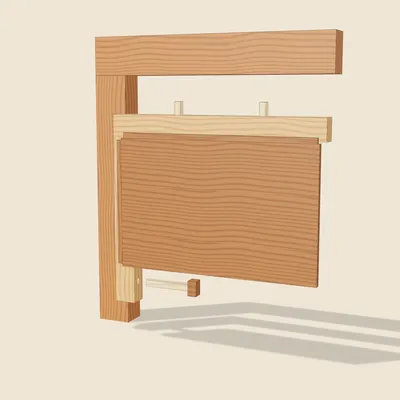
How it works
The screen
Carved screens (花罩) come in several forms: with two short legs like a table, falling to the floor, with railings at the sides, or as a full partition with a round or octagonal opening. The screen itself is a frame round a carved board, usually of fine hardwood 1.5–2 cun thick, which keeps a plain border on its edge; the border is joined to the frame with tongues or pins.
Pinned in
Because interior screens are meant to be moved, the whole screen is fitted with pins: pins on the top rail go into holes in the hanging sill, and a decorated pin passes through the foot of each side stile into the frame. Pull out the two pins and the screen comes down.
The carving is not modelled; sizes are illustrative.
Proportions in the model are illustrative.
How it's made
 Step 1
Screen
A carved screen in a doorway.
 Step 2
Panel
Panel held in the frame by its edges.
 Step 3
Pins
Pins on the top rail.
 Step 4
Up into the sill
Into holes in the sill.
 Step 5
Through-pin
A pin through the stile into the jamb.
 Step 6
Removable
Pull the pins and it comes out.
Variations
Railing screen (栏杆罩)
Two extra uprights with railings divide the opening into three.
Round or octagonal opening
A full partition with a round or eight-sided doorway.
Can you CNC this?
Possible, with design or setup changes
Frame, pin holes and grooves are straightforward; the carved openwork panel is a separate 2.5D or 3D carving job.
Free STL downloads (one file per part)
- Hanging sill 挂空槛 · huazhao-hanging-sill.stl
- Jamb 抱框 · huazhao-jamb.stl
- Screen frame with pins 花罩边框(带栽销) · huazhao-screen-frame.stl
- Panel (carving omitted) 罩心(雕刻从略) · huazhao-panel.stl
- Through pin 插销 · huazhao-through-pin.stl
Before cutting or printing, read the CNC and 3D-printing notes on tool radius, scaling the STL files and their licence.
Related joints
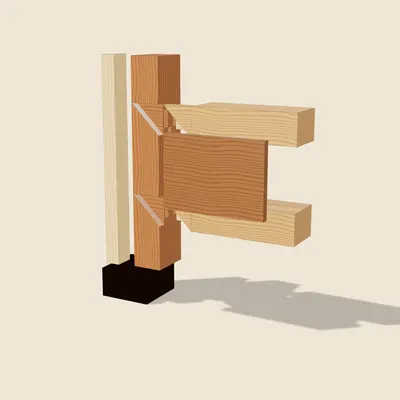
Lattice Door Frame
géshàn biānmǒThe rails of a lattice door join the stiles with two tenons and a mitred face; panels sit in grooves, and a pivot post fixed to the stile turns in sockets.
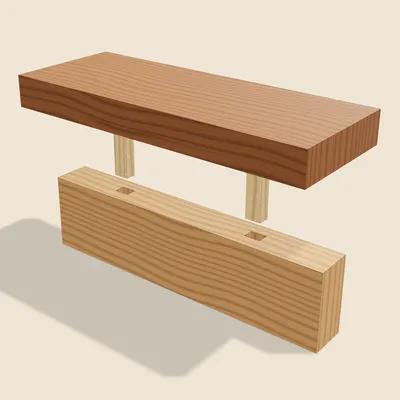
Loose Tenon
zāi xiāoThe tenon is a separate piece of wood planted into mortises in both parts, easy to replace if it wears.

Hidden Dowel
àn xiāoTwo lengths meet end to end and a square pin hidden inside the joint keeps them in line: nothing shows outside.
Questions
Is the screen glued in?
No, it is pinned so it can be removed.
What wood is used?
Fine hardwoods such as rosewood or nanmu.
Is the carving modelled?
No, the panel is shown plain.
Further reading
- 马炳坚《中国古建筑木作营造技术》第二版(Ma Bingjian, Timber Construction Techniques of Traditional Chinese Buildings, 2nd ed.),第 287–290 页,图 7-24、7-25
- 马炳坚《中国古建筑木作营造技术》第二版(Ma Bingjian, Timber Construction Techniques of Traditional Chinese Buildings, 2nd ed.),第 290–291 页