
Hezhu Gumao (合柱鼓卯): How Song Builders Made One Column from Two Pieces
Composite column · 合柱 · 暗鼓卯 · 两段合
Big columns need big trees, and big trees were scarce.
The Yingzao Fashi shows how to build one column from two or three pieces.
- Chinese
- 合柱鼓卯 · hézhù gǔmǎo
- Joins
- Two (or three) lengthwise pieces of one column
- Found in
- Song-dynasty large halls
- Signature parts
- Bow-tie keys across the seam
- Compare
- Butterfly key
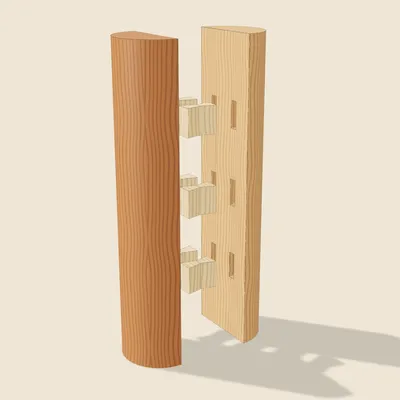
How it works
The drawing
Juan 30 has a plate of its own, 合柱鼓卯第七. It draws a column made of two pieces (兩段合) and one of three (三段合), with small keys set along the seams at four heights. A cross-section (正樣) shows two bow-tie keys across the seam, hidden inside (暗鼓卯). Beside it are visible keys let into the surface and covered (蓋鞠明鼓卯), and small blocks.
The bow-tie
鼓卯 is a key wide at both ends and narrow in the middle. The same book lists iron ones for tying stone blocks: each end 2 cun wide and 1 cun long, the waist 4 cun long. A wooden key of this shape across the seam pulls the two pieces together.
Inferred reconstruction (推断复原)
This joint is an inferred reconstruction. It is inferred from: the 合柱鼓卯 plate in juan 30, its cross-section, and the iron 鼓卯 in juan 26. Inferred, not sourced: the size and proportions of the wooden keys (borrowed from the iron ones), their number and spacing, and how they are fitted; the three-piece version and the surface keys are not modelled.
History
The drawing
Juan 30 has a plate of its own, 合柱鼓卯第七. It draws a column made of two pieces (兩段合) and one of three (三段合), with small keys set along the seams at four heights. A cross-section (正樣) shows two bow-tie keys across the seam, hidden inside (暗鼓卯). Beside it are visible keys let into the surface and covered (蓋鞠明鼓卯), and small blocks. (Yingzao Fashi juan 三十 (plate scan p. 31)).
鼓卯 is a key wide at both ends and narrow in the middle. The same book lists iron ones for tying stone blocks: each end 2 cun wide and 1 cun long, the waist 4 cun long. A wooden key of this shape across the seam pulls the two pieces together.
Inferred reconstruction (推断复原). This joint is an inferred reconstruction. It is inferred from: the 合柱鼓卯 plate in juan 30, its cross-section, and the iron 鼓卯 in juan 26. Inferred, not sourced: the size and proportions of the wooden keys (borrowed from the iron ones), their number and spacing, and how they are fitted; the three-piece version and the surface keys are not modelled.
Proportions
The bow-tie
鼓卯 is a key wide at both ends and narrow in the middle. The same book lists iron ones for tying stone blocks: each end 2 cun wide and 1 cun long, the waist 4 cun long. A wooden key of this shape across the seam pulls the two pieces together.
Proportions in the model are illustrative.
Common mistakes
Common mistakes
- Leaving the bow-tie keys visible on the outside. This page models the hidden keys (暗鼓卯) inside the seam; surface keys (蓋鞠明鼓卯) are a different drawing on the same plate.
- Treating wooden key size and spacing as book figures for timber. Shape follows the iron 鼓卯 in juan 26 (ends 2 cun wide, waist 4 cun long); wooden sizes and spacing here are inferred.
- Reading a three-piece column as the same model. Juan 30 also draws 三段合; this reconstruction is the two-piece (兩段合) version only.
- Confusing it with a furniture butterfly key. Same bow-tie idea, different use: here the keys splice a built-up column. Compare yinding-sun.
Related joints elsewhere
Related forms
Western and Japanese workshops have relatives that share a geometric idea (scarf, bridle, dovetail, halving, keyed splice) under other names; they are bridges for readers, not claims of descent.
Stay with the Chinese construction on this page before renaming a piece. See also Compare two joints when a look-alike is listed there.
How it's made
 Step 1
Column
A column made of two pieces.
 Step 2
Apart
Split along its length.
 Step 3
Keys
Bow-tie keys across the seam.
 Step 4
Shape
Wide at both ends, narrow at the waist.
 Step 5
Close
The other half closes over them.
 Step 6
Hidden
Hidden: the column looks solid.
Variations
Three pieces (三段合)
Three pieces with keys on each seam.
Surface keys (蓋鞠明鼓卯)
Keys let into the outside and covered over.
Can you CNC this?
Possible, with design or setup changes
Bow-tie pockets are 2D pockets from the flat seam face; the half-round outside needs turning or a 4th axis.
Free STL downloads (one file per part)
- Half column A 半柱甲 · hezhu-gumao-half-column-a.stl
- Bow-tie key 1 鼓卯1 · hezhu-gumao-bow-tie-1.stl
- Bow-tie key 2 鼓卯2 · hezhu-gumao-bow-tie-2.stl
- Bow-tie key 3 鼓卯3 · hezhu-gumao-bow-tie-3.stl
- Bow-tie key 4 鼓卯4 · hezhu-gumao-bow-tie-4.stl
- Bow-tie key 5 鼓卯5 · hezhu-gumao-bow-tie-5.stl
- Bow-tie key 6 鼓卯6 · hezhu-gumao-bow-tie-6.stl
- Half column B 半柱乙 · hezhu-gumao-half-column-b.stl
Before cutting or printing, read the CNC and 3D-printing notes on tool radius, scaling the STL files and their licence.
Related joints
Palm Splice
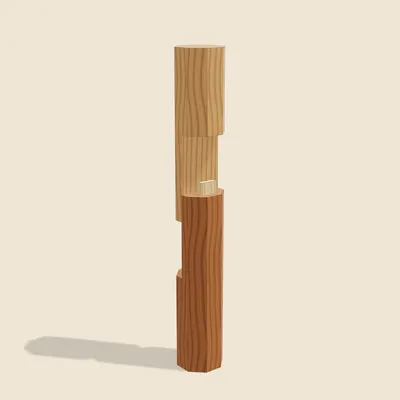
bāzhang sǔnOld column and new foot are each cut to a half-thickness “palm”; the palms overlap, short tenons lock their ends, and iron hoops bind it.
Butterfly Key
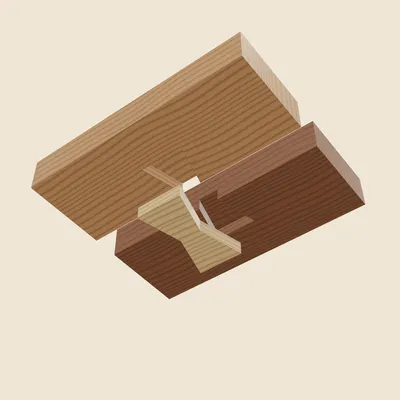
yíndìng sǔnA bow-tie key, two dovetails back to back, let in across a seam to lock thick boards together.
Beam-to-Column Dovetail
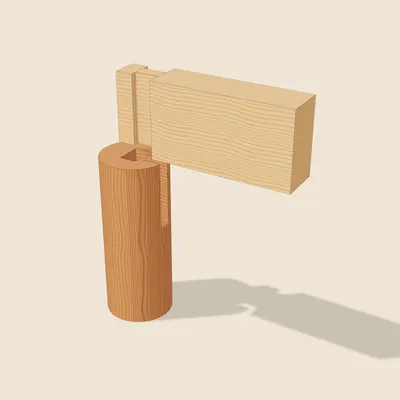
liáng zhù gǔmǎoThe beam end carries a dovetail, narrow at the neck and wide at the head, which drops from above into a slot of the same shape cut down the column top; it cannot be pulled out sideways.
Questions
Why build up a column?
Large single trees were scarce.
Are the keys visible?
In this version no, they are hidden in the seam.
Are the sizes from the book?
No; the shape follows the iron cramps of juan 26, the sizes are inferred.