
Qianjia Shi (嵌夹式): the Single-Tenon Mitred Corner for Thin Strips
Clamped corner · 嵌夹式板条角接合
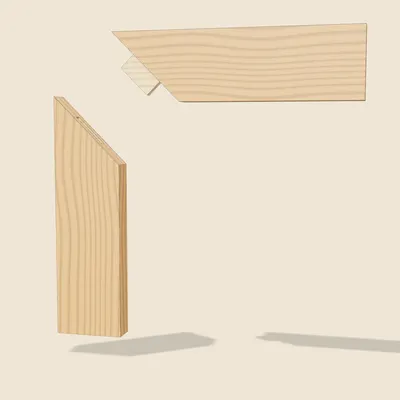
The best way to join two thin strips at a corner gives each strip a tenon.
The clamped corner is the cheaper way: one tenon, one slot.
- Chinese
- 嵌夹式 · qiànjiā shì
- Joins
- Two thin strips at a corner
- Found in
- Aprons with spandrels, open frames
- Signature parts
- 45° mitre · one short tenon · slot
- Compare
- Tucked-sleeve joint
How it works
One tenon, one slot
The two strips still meet in a 45° mitre, but only one of them puts out a tenon; the other is slotted to take it. Wang Shixiang notes that with a single tenon, and a short one, the joint is not very strong.
Palm to palm
A still simpler version (合掌式) gives no tenon at all: each strip leaves a thin flap and the two flaps meet like palms pressed together. The book shows both methods side by side.
Where it fits
These are the cheaper relatives of the tucked-sleeve joint, used on the same aprons and open frames.
How it's made
 Step 1
Corner
Two strips meet at a corner.
 Step 2
Mitre
Both are cut to a 45° mitre.
 Step 3
One tenon
Only one strip has a tenon.
 Step 4
Slot
The other is slotted.
 Step 5
Together
The tenon goes into the slot.
 Step 6
Weaker
One short tenon: less strong.
Variations
Palm to palm (合掌式)
No tenon: each strip leaves a thin flap and the flaps meet face to face.
Can you CNC this?
Yes, with small changes
The mitre, the tongue and the slot are all straight cuts in thin stock. The slot is cut into the mitre face, so the strip has to be held at 45° or on end.
Free STL downloads (one file per part)
- Horizontal strip with tenon 横条(带榫舌) · qianjia-shi-rail.stl
- Upright strip, slotted 立条(开槽) · qianjia-shi-upright.stl
Before cutting or printing, read the CNC and 3D-printing notes on tool radius, scaling the STL files and their licence.
Related joints
Tucked-Sleeve Joint
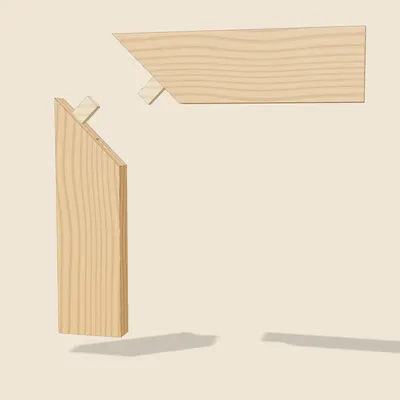
chuāichuāi sǔnTwo strips meet at a 45° corner and each sends one hidden tenon into the other, like two hands tucked into opposite sleeves.
Mitred-Shoulder Joint
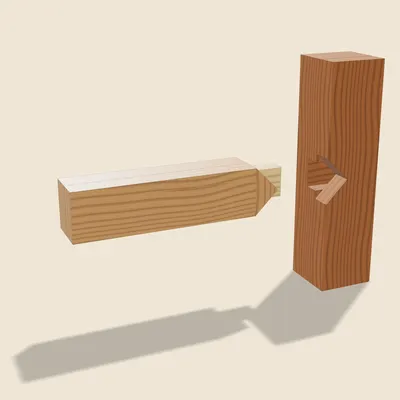
géjiān sǔnWhere a rail meets a post, its outer face is cut to a point that fits a matching notch, so mouldings meet cleanly.
Elongated Bridle Joint
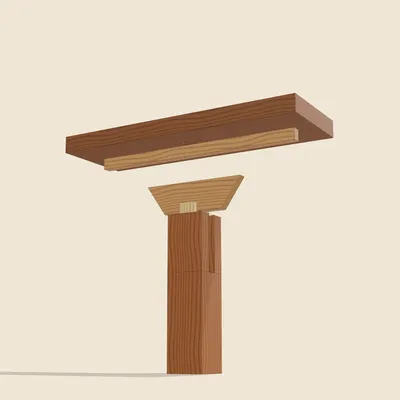
jiātóu sǔnThe leg top is slotted to clamp the apron and its spandrel heads, then tenons into the top.
Questions
How is it different from the chuaichuai joint?
Only one strip has a tenon instead of both.
Is it strong?
Less so: the single tenon is short.
What is the palm-to-palm version?
Each strip leaves a flap; the flaps meet without a tenon.
Further reading
- 王世襄《明式家具研究》(Wang Shixiang, Research on Ming Furniture),第 106 页
- 王世襄《明式家具研究》(Wang Shixiang, Research on Ming Furniture),第 108 页,图 3.19a、3.19b