
Stepped Tenon (阶梯榫, 踏步榫): How a Cross Beam Sits on a Round Purlin
Step tenon · 踏步榫 · 趴梁阶梯榫
Some beams in a Qing roof do not sit on columns: they lie across the purlins.
They hold on with a tenon cut in steps.
- Chinese
- 阶梯榫 · jiētī sǔn
- Also called
- 踏步榫
- Joins
- Cross beam (趴梁) to round purlin
- Found in
- Qing timber roofs, hip and corner framing
- Signature parts
- Three steps · ¼-radius depth · dovetailed top step
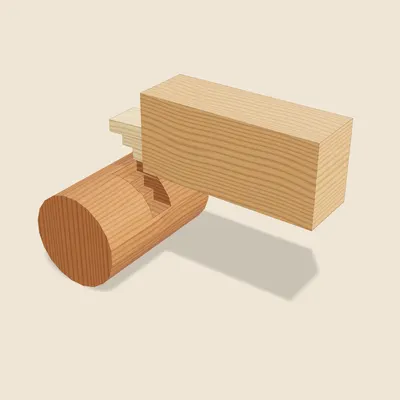
How it works
A beam that lies across
Ma Bingjian describes the stepped tenon as used where a beam lying across (趴梁) or a diagonal corner beam meets a purlin, and where short and long cross beams meet.
Three steps
The tenon is usually made in three layers. The bottom layer goes into the purlin a quarter of its radius; the second is the same; the third may be dovetailed to pull the parts together, or straight. The tenon reaches no further than the purlin’s centre, and a quarter is left on each side as cover (包掩).
Proportions in the model are illustrative.
How it's made
 Step 1
Across
A beam laid across a purlin.
 Step 2
First step
Bottom step: a quarter radius deep.
 Step 3
Second step
The second step the same.
 Step 4
Top step
Top step dovetailed, to the centre.
 Step 5
Socket
A stepped socket; sides left as cover.
 Step 6
Drop in
Dropped in from above.
Variations
Corner beam
A diagonal corner beam uses the same tenon cut at 45°.
Straight top step
The top step may be straight instead of dovetailed.
Can you CNC this?
Hard on a 3-axis machine as drawn
The socket is a stepped pocket in a round purlin, cut from above but with a dovetailed top layer, which is undercut. It may need a cradle for the round timber and a dovetail bit or hand work.
Free STL downloads (one file per part)
- Round purlin 桁檩 · jieti-sun-purlin.stl
- Cross beam with stepped tenon 趴梁(带阶梯榫) · jieti-sun-cross-beam.stl
Before cutting or printing, read the CNC and 3D-printing notes on tool radius, scaling the STL files and their licence.
Related joints
Purlin Dovetail
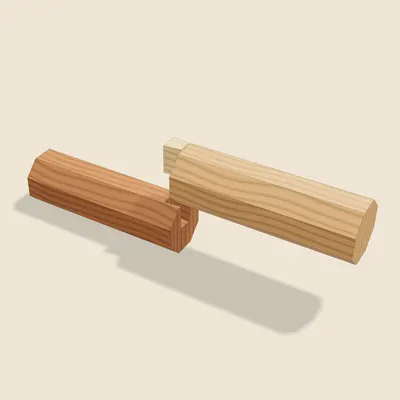
héng lǐn yànwěiWhere two purlins meet over a beam head, one carries a dovetail half its diameter high that drops into a socket in the other.
Dovetail Joint
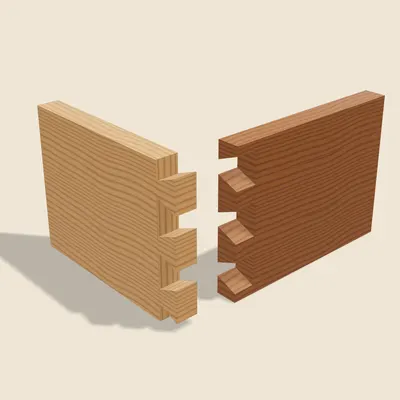
yànwěi sǔnA tenon wider at the tip than at the root, so it can’t pull out: found in boxes, drawers, tables and temple beams.
Shiplap Joint
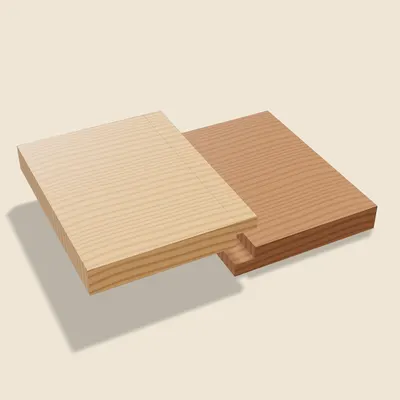
qǐkǒu sǔnEach board edge keeps half its thickness as a lip; the lips overlap, so the seam never opens straight through.
Questions
Why steps?
They seat the beam on the round purlin without cutting too deep.
How deep is each?
A quarter of the purlin radius.
How far does it reach?
No further than the purlin’s centre.
Further reading
- 马炳坚《中国古建筑木作营造技术》第二版(Ma Bingjian, Timber Construction Techniques of Traditional Chinese Buildings, 2nd ed.),第 127–128 页,图 3-15
- 马炳坚《中国古建筑木作营造技术》第二版(Ma Bingjian, Timber Construction Techniques of Traditional Chinese Buildings, 2nd ed.),第 125 页