
Round Frame Joinery (圆香几攒边): How a Round Incense Stand Top Is Framed
Round frame · 圆香几攒边打槽
A round top cannot be framed with mitres like a square one.
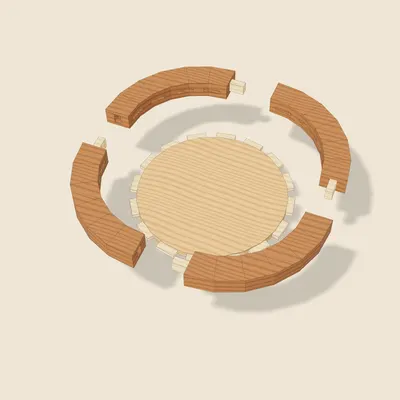
Its frame is built from curved segments joined end to end around the circle.
- Chinese
- 圆香几攒边 · yuán xiāngjǐ cuánbiān
- Joins
- Four curved frame segments and the panel
- Found in
- Round incense stands, round stools, round tables
- Signature parts
- Curved segments · end tenons · panel groove
- Compare
- Frame and panel
How it works
Curved segments
Wang Shixiang describes round frames, such as incense stand tops and round stools, as made from curved pieces, usually four. Apart from the wedged scarf joint (楔钉榫), they are often joined one into the next: each segment is slotted at one end and tenoned at the other.
Panel in a groove
As in a square frame, the inner edge is grooved for the panel’s tongue, and battens and mortises are laid out the same way.
Proportions in the model are illustrative.
How it's made
 Step 1
Round top
A round top.
 Step 2
Segments
The frame in four curved segments.
 Step 3
Ends
One end tenoned, one end slotted.
 Step 4
Ring
Each takes the next.
 Step 5
Panel
The panel tongue into the groove.
 Step 6
Closed
A closed round frame.
Variations
Wedged scarf
Segments can also be joined with the wedged scarf joint (楔钉榫).
Can you CNC this?
Possible, with design or setup changes
The curved segments are 2D profiles, but the end tenons and slots and the inside groove run along a curve and on end grain, which may need a slot cutter or the segment stood on end.
Free STL downloads (one file per part)
- Curved frame segment 1 弧形边框第1段 · yuan-xiangji-frame-segment-1.stl
- Curved frame segment 2 弧形边框第2段 · yuan-xiangji-frame-segment-2.stl
- Curved frame segment 3 弧形边框第3段 · yuan-xiangji-frame-segment-3.stl
- Curved frame segment 4 弧形边框第4段 · yuan-xiangji-frame-segment-4.stl
- Panel with tongue 面心(带榫舌) · yuan-xiangji-panel.stl
Before cutting or printing, read the CNC and 3D-printing notes on tool radius, scaling the STL files and their licence.
Related joints
Frame and Floating Panel
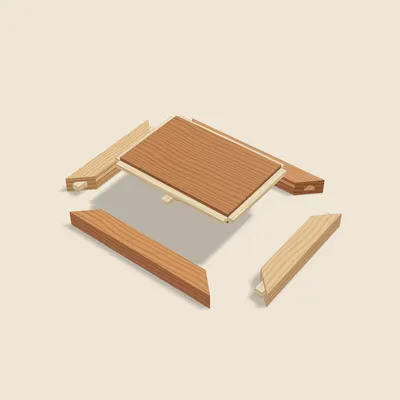
cuánbiān dǎcáo zhuāngbǎnA mitred frame grooved on the inside, a thin panel with a tongued edge floating in the groove, and battens underneath.
Wedged Scarf Joint
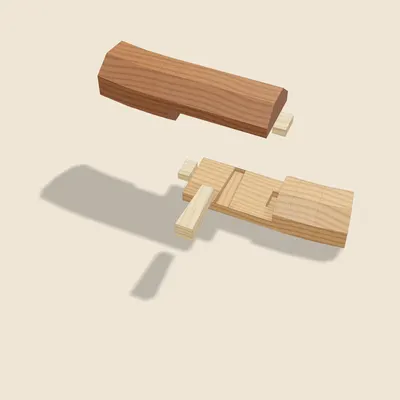
xiēdīng sǔnCurved pieces lapped with hooked tips and locked by a tapered key through the middle: how a horseshoe chair arm is built.
Leg and Base Frame
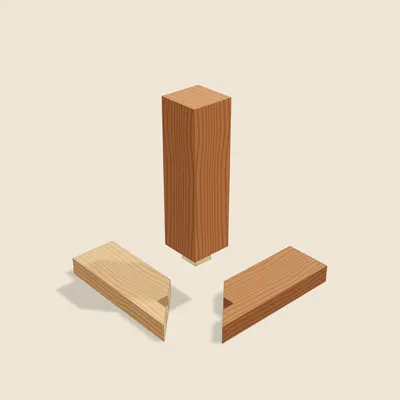
tuǐzú yǔ tuōníThe base frame is mitred at each corner; at the seam a socket wide at the bottom takes a matching tenon on the foot, and the frame is assembled around it.
Questions
How many segments?
Usually four.
How are they joined?
Each slotted at one end and tenoned at the other, or with a wedged scarf.
How is the panel held?
In a groove on the inner edge.
Further reading
- 王世襄《明式家具研究》(Wang Shixiang, Research on Ming Furniture),第 110 页
- 王世襄《明式家具研究》(Wang Shixiang, Research on Ming Furniture),第 112 页,图 3.27
- 王世襄《明式家具研究》(Wang Shixiang, Research on Ming Furniture),第 106 页
- 王世襄《明式家具研究》(Wang Shixiang, Research on Ming Furniture),第 109 页,图 3.22a、3.22b