
Jiaoya (角牙): Corner Brackets Fitted into Grooves
Corner bracket · 角牙
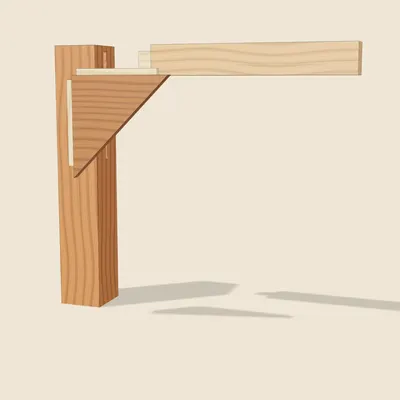
Where a rail meets a post, a small bracket in the corner keeps the angle from racking.
The simplest way to fix it: cut grooves in both members and fit the bracket in.
- Chinese
- 角牙打槽嵌装 · jiǎoyá dǎcáo qiànzhuāng
- Joins
- Corner bracket to rail and post
- Found in
- Cabinets, clothes racks, washstands, tables
- Signature parts
- Grooves in both members · tongued bracket edges
- Compare
- Bracket tenon
How it works
Why corner brackets
Wang Shixiang explains that corner brackets sit at the T-junctions of rails and posts to keep the angle fixed and stiffen the frame, and they give room for carving.
Three ways to fit them
A bracket may be fitted into grooves cut in both the rail and the post; it may go into a groove on one side and take a loose tenon on the other; or it may carry its own tenon on one side and a loose tenon on the other. The model shows the first, with the bracket’s outline simplified.
Proportions in the model are illustrative.
How it's made
 Step 1
Bracket
A bracket in the corner.
 Step 2
Rail
The rail tenons into the post.
 Step 3
Grooves
Grooves in both members.
 Step 4
Tongues
Tongues on the two straight edges.
 Step 5
Fit
The bracket fits into the grooves.
 Step 6
Why
It keeps the corner square.
Variations
Groove and loose tenon
One edge in a groove, the other on a loose tenon.
Tenon and loose tenon
One edge with its own tenon, the other on a loose tenon.
Can you CNC this?
Yes, with small changes
The grooves in the rail and post are straight slots, and the bracket outline and its edge tongues are 2D cuts. The groove ends will be rounded.
Free STL downloads (one file per part)
- Post 竖材 · jiaoya-dacao-post.stl
- Rail 横材 · jiaoya-dacao-rail.stl
- Corner bracket 角牙 · jiaoya-dacao-corner-bracket.stl
Before cutting or printing, read the CNC and 3D-printing notes on tool radius, scaling the STL files and their licence.
Related joints
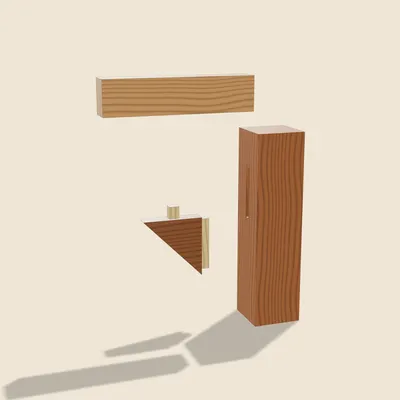
Corner-Bracket Joint
tuōjiǎo sǔnThe small carved bracket under a table corner: tongued into a groove in the leg and pegged into the apron.
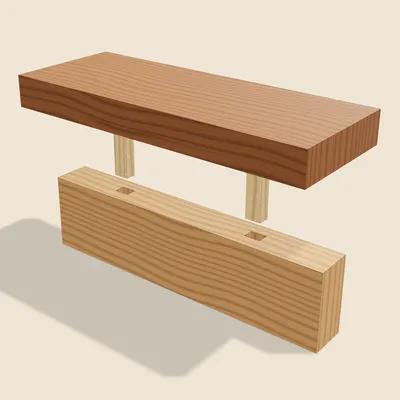
Loose Tenon
zāi xiāoThe tenon is a separate piece of wood planted into mortises in both parts, easy to replace if it wears.
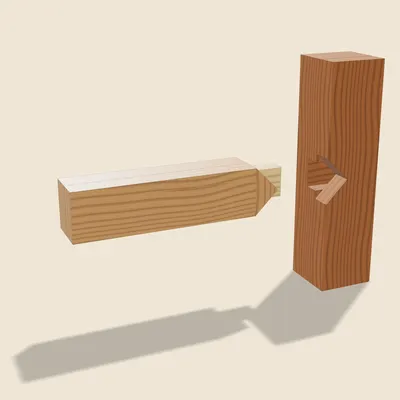
Mitred-Shoulder Joint
géjiān sǔnWhere a rail meets a post, its outer face is cut to a point that fits a matching notch, so mouldings meet cleanly.
Questions
What does it do?
It stiffens the corner and keeps it square.
How is it held?
Its straight edges sit in grooves.
Is the carving shown?
No, the outline is simplified.
Further reading
- 王世襄《明式家具研究》(Wang Shixiang, Research on Ming Furniture),第 117 页
- 王世襄《明式家具研究》(Wang Shixiang, Research on Ming Furniture),第 116 页,图 3.39a–c