Guazhu Twin Blind Tenons (瓜柱双半榫)
Twin stub tenons · 瓜柱榫
In a Chinese roof frame, the beams step up towards the ridge on short posts called guazhu, “melon posts”.
Each one stands on the beam below on two blind tenons side by side.
- Chinese
- 瓜柱双半榫 · guāzhù shuāng bàn sǔn
- Joins
- Short post (瓜柱) to the back of a beam
- Found in
- Stepped roof frames (抬梁式)
- Signature parts
- Two blind tenons · shoulders shaped to the beam back
- Related
- Mantou tenon at the post head
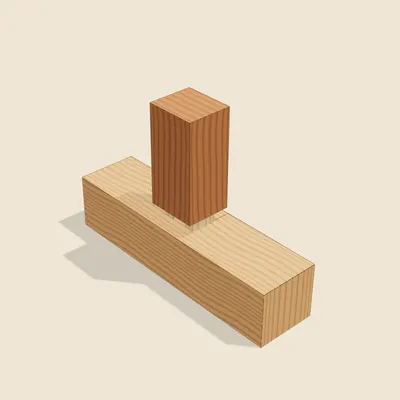
How it works
A post on a beam
A short post stands on the back of the beam below and carries the next beam or the ridge.
Two tenons
The foot of the post has two straight tenons that go into blind mortises in the beam back. A building-conservation guide describes the tenons as entering the beam vertically, and says their shoulders should follow the curve of the beam back.
In the model
The beam back is drawn flat here for clarity.
How it's made
 Step 1
A short post
The post stands on the beam back.
 Step 2
Two tenons
Cut two tenons at its foot.
 Step 3
Two mortises
Cut two blind mortises in the beam back.
 Step 4
Set it down
Set the post straight down.
 Step 5
Shoulders
Shape the shoulders to the beam back.
 Step 6
Steady
Two tenons keep it from turning.
Variations
With a corner brace
Ridge posts are often steadied with a brace (角背) at the foot.
Can you CNC this?
Yes, with small changes
The two blind mortises are cut straight down into the beam back and suit a 3-axis machine; round their corners or the tenon edges. The tenons are on the end of the post, which may need clamping upright. Shaping the shoulders to a curved beam back is harder and may need 3D passes or hand fitting.
General note: a round cutter cannot leave a sharp inside corner, so every recess keeps the tool radius. Round the mating edges or add dogbone reliefs. Sloping faces, undercuts and curves may need special bits, extra setups or more axes.
Free STL downloads (one file per part)
- Beam 梁 · guazhu-sun-beam.stl
- Short post (guazhu) 瓜柱 · guazhu-sun-short-post.stl
Proportions are illustrative, not measured dimensions. The files are unitless: scale them to suit and check fits and allowances before cutting. Each file is a closed (watertight) solid with its mortises and slots already cut, exported in its assembled position, ready to import into CAM or modelling software. Licence: CC BY 4.0 (credit: Chinese Joinery).
Related joints
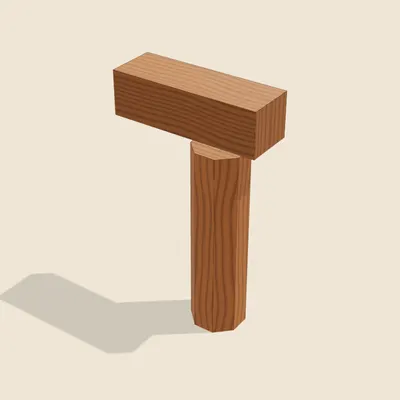
Column-Head Tenon
mántou sǔnA short square tenon on the column head fits a socket under the beam, so the beam can’t slide off.
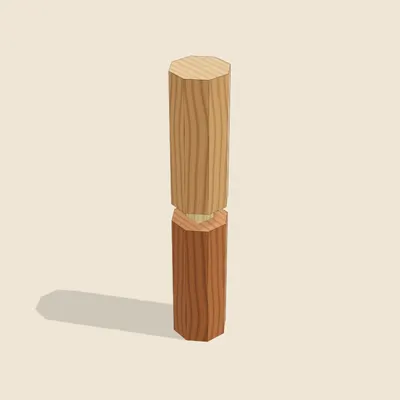
Hidden Dowel
àn xiāoTwo lengths meet end to end and a square pin hidden inside the joint keeps them in line: nothing shows outside.
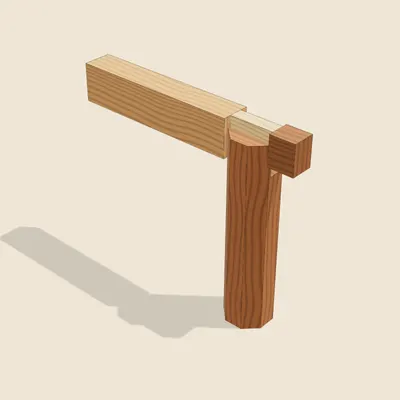
Clasping-Head Tenon
gūtóu sǔnThe beam drops into a slot across the column head and runs on past it; the head beyond “clasps” the column.
Questions
What is a guazhu?
A short post standing on a beam in a Chinese roof frame.
How is it fixed?
With two blind tenons into the beam back.
Why two tenons?
Two tenons hold it in line along the beam.