Chaoshou Sun (抄手榫): Battens Driven From Both Sides
Opposed battens · 大小头抄手穿带
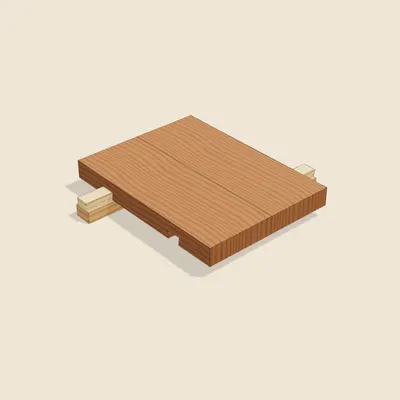
A batten slid into a tapered dovetail groove holds boards flat. Drive every batten from the same side, though, and the panel can creep the other way.
The chaoshou method drives them from opposite sides, like hands folded into opposite sleeves.
- Chinese
- 抄手榫 · chāoshǒu sǔn
- Also called
- 大小头抄手穿带
- Joins
- Battens to a panel of boards
- Found in
- Solid plank doors (实榻门), board panels
- Compare
- Sliding dovetail batten
How it works
Tapered grooves
Dovetail grooves are cut across the back of the boards, wide at one end and narrow at the other.
From opposite sides
The tapered battens are driven in from alternate sides, so one batten’s big end sits on the left and the next one’s on the right. A building-conservation guide says this “big-and-small-end, folded-hands” method keeps the seams tight and stops them splitting.
Proportions
The same guide gives the groove depth as two fifths to one half of the board thickness (never more than half), and the flare of each dovetail side as one tenth of the depth.
How it's made
 Step 1
Boards
Lay the boards edge to edge.
 Step 2
Tapered grooves
Cut tapered dovetail grooves underneath.
 Step 3
Tapered batten
Each batten is wide at one end.
 Step 4
First batten
Drive the first from one side.
 Step 5
Next one
Drive the next from the opposite side.
 Step 6
Tight seams
The seams pull tight and resist splitting.
Variations
Raised or flush battens
On “hard” battens the batten stands proud of the face; on “soft” ones the face stays flush.
Hidden battens
Solid doors may use battens hidden within the thickness.
Can you CNC this?
Possible, with design or setup changes
Each tapered dovetail groove can be cut with a dovetail bit from the face, with the taper programmed in plan. The battens may need cutting on their side or with the same bit. The fit of each batten usually needs tuning.
General note: a round cutter cannot leave a sharp inside corner, so every recess keeps the tool radius. Round the mating edges or add dogbone reliefs. Sloping faces, undercuts and curves may need special bits, extra setups or more axes.
Free STL downloads (one file per part)
- Board A 拼板 A · chaoshou-sun-board-a.stl
- Board B 拼板 B · chaoshou-sun-board-b.stl
- Batten A 穿带 A · chaoshou-sun-batten-a.stl
- Batten B (opposite way) 穿带 B(反向) · chaoshou-sun-batten-b.stl
Proportions are illustrative, not measured dimensions. The files are unitless: scale them to suit and check fits and allowances before cutting. Each file is a closed (watertight) solid with its mortises and slots already cut, exported in its assembled position, ready to import into CAM or modelling software. Licence: CC BY 4.0 (credit: Chinese Joinery).
Related joints
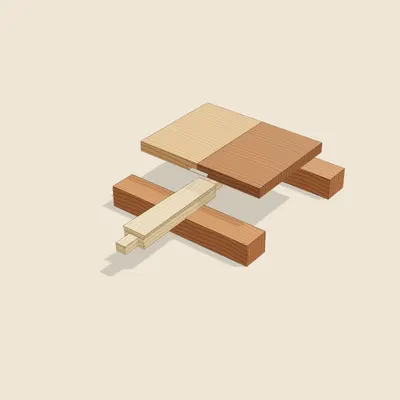
Sliding Dovetail Batten
chuāndàiA tapered dovetail batten driven across the back of a panel, its ends tenoned into the frame: the reason old tabletops stay flat.
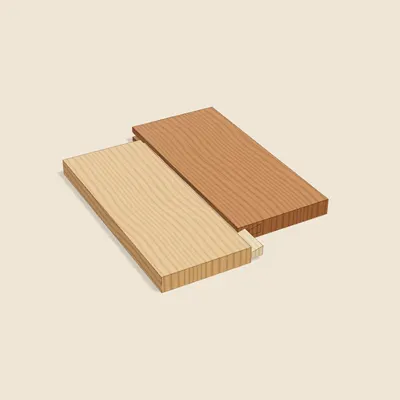
Longfeng Board Joint
lóngfèng sǔnA half-dovetail tongue on one board slides into a matching groove in the next, so the seam can neither step nor pull apart.
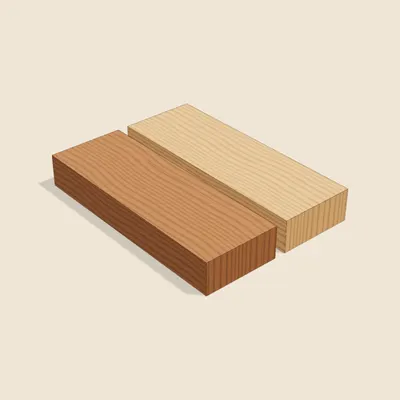
Plain Glued Edge Joint
píngkǒu jiāohéTwo thick boards with edges planed dead straight on a very long plane, glued face to face: no tenons, no battens.
Questions
What is a chaoshou batten?
Tapered dovetail battens driven in from opposite sides.
Why opposite sides?
It keeps the panel from creeping one way and closes the seams.
How deep is the groove?
A conservation guide gives 2/5 to 1/2 of the board thickness.